Problem Statement
A rectangular plane surface 3 m wide and 4 m deep lies in water in such a way that its plane makes an angle of 30° with the free surface of water. Determine the total pressure force and position of centre of pressure, when the upper edge is 2 m below the free surface.
Given Data
- Width of plane surface, \( b = 3 \, \text{m}\)
- Depth (length) of plane surface, \( d = 4 \, \text{m}\)
- Angle of inclination with free surface, \( \theta = 30^\circ \)
- Vertical depth of upper edge, \( h_{top} = 2 \, \text{m}\)
- Density of water, \( \rho = 1000 \, \text{kg/m}^3 \)
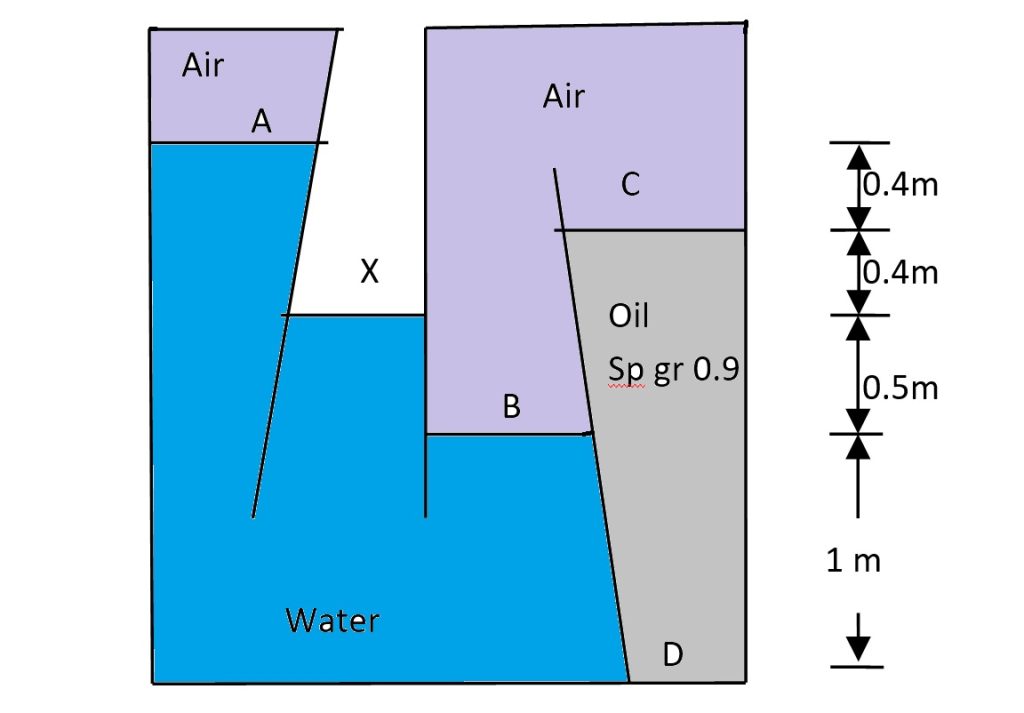
Diagram of the Inclined Surface
The setup showing the rectangular plane immersed at an angle in water.

Solution
(i) Total Pressure (Force)
First, calculate the area of the plate and the vertical depth to its centroid (\(\bar{h}\)).
Now, calculate the total pressure force (F).
(ii) Position of Centre of Pressure (\(h^*\))
First, find the moment of inertia (\(I_G\)) of the rectangular area about its centroidal axis.
Now, use the formula for the vertical depth to the centre of pressure for an inclined plane.
Total Pressure (Force): \( F \approx 353.16 \, \text{kN} \)
Centre of Pressure (Vertical Depth): \( h^* \approx 3.111 \, \text{m} \) below the free surface
Explanation of Concepts
Pressure on Inclined Surfaces: For a submerged plane that is not vertical, the pressure calculations must account for the angle. The total force still depends on the vertical depth to the centroid (\(\bar{h}\)), not the slant distance. The centre of pressure, which is the point where the resultant force acts, is also calculated based on its vertical depth (\(h^*\)). The term \(\sin^2\theta\) in the formula for \(h^*\) corrects the moment of inertia for the inclination of the plane, ensuring the final result is a vertical depth from the free surface.
Physical Meaning
The inclined rectangular surface is subjected to a total force of 353,160 N, which is equivalent to the weight of over 36 metric tons. This represents the immense load that the submerged plate must be engineered to withstand.
The centre of pressure is located at a vertical depth of 3.111 m from the water surface. As expected, this point is slightly below the centroid's vertical depth of 3.0 m. Any structural supports or hinge mechanisms for this plate must be designed to handle the entire force acting at this precise location to ensure stability and prevent failure.