
Table of Contents
ToggleIn the world of surveying, where millimeters can make monumental differences, the choice of measuring tool is very important. While modern technology has introduced laser measures and GPS devices, the classic measuring tape remains a staple in a surveyor’s toolkit. But not all tapes are created equal.
From the flexible cloth tapes that can snake around obstacles to the high-precision invar tapes used in scientific measurements, each type of tape serves a unique purpose in the surveyor’s arsenal. In this article, we’ll unravel the mysteries of four key players in the tape measure family: the versatile cloth or linen tapes, the sturdy metallic tapes, the reliable steel tapes, and the specialized invar tapes.
1.Cloth or Linen Tapes
Cloth or linen tapes are made of closely woven linen fibers and varnished to resist moisture. They typically range from 10 to 30 meters in length and are 12 to 15 mm wide. These tapes are primarily used for measuring offsets due to their flexibility and lightweight nature. They are particularly useful in situations where a rigid tape might be impractical.
Characteristics of Cloth or Linen Tapes
- Made of closely woven linen fibers
- Varnished to resist moisture
- Length ranges from 10 to 30 meters
- Width is typically 12 to 15 mm
- Usually have a brass or metal ring at one end, included in the total length
- Often marked in both metric and imperial units

Advantages of Cloth or Linen Tapes
- Easy to handle and lightweight
- Highly flexible, making them ideal for irregular terrains
- Useful for measuring offsets
- Can be easily rolled or folded for compact storage
- Generally less expensive than metal tapes
- Versatile due to dual unit markings (metric and imperial)
Disadvantages of Cloth or Linen Tapes
- Easily affected by moisture, causing shrinkage
- Prone to stretching and alteration of length over time
- May twist and tangle during use
- Not as strong as chain or steel tapes
- Can be difficult to use in strong winds
- Figures may become indistinct with continuous use
- Less durable than metal tapes, requiring more frequent replacement
- Less precise for high-accuracy measurements compared to metal tapes
While cloth or linen tapes have limitations in terms of durability and precision, their flexibility and ease of use make them valuable tools for certain surveying tasks, particularly in taking offset measurements or in areas with irregular terrain.
2.Metallic Tapes
Metallic tapes are an improvement over cloth tapes, consisting of a linen tape reinforced with brass or copper wires to prevent stretching or twisting of fibers. The wires are interwoven and not visible to the naked eye due to varnishing.
Characteristics of Metallic Tapes
- Composed of linen reinforced with brass or copper wires
- Varnished surface concealing the interwoven wires
- Available in various lengths, with 20m and 30m being most common
- Usually supplied in leather cases with a winding device
- Divided into decimeters and centimeters for precise measurements
- Typically wider than cloth tapes, providing better handling

Advantages of Metallic Tapes
- More durable than cloth tapes due to metal reinforcement
- Resistant to stretching and twisting, maintaining accuracy over time
- More accurate than cloth tapes for measurements
- Suitable for a wider range of surveying tasks
- Commonly used for offset measurements in chain surveying
- Leather case and winding device offer better protection and storage
- Easier to read due to clear markings and reduced wear
Disadvantages of Metallic Tapes
- Heavier than cloth tapes, which may affect portability
- More expensive than cloth tapes
- Can be affected by temperature changes, though less than steel tapes
- May still be prone to some stretching over extended use
- Not as accurate as steel or invar tapes for high-precision measurements
- Can be damaged if bent sharply or kinked
- Requires more careful handling and storage than cloth tapes
Metallic tapes offer a good balance between the flexibility of cloth tapes and the durability of steel tapes, making them versatile tools for many surveying applications. Their improved accuracy and resistance to stretching make them particularly useful for offset measurements in chain surveying and other tasks requiring moderate precision.
3.Steel Tapes
Steel tapes offer a higher degree of accuracy compared to cloth and metallic tapes. They consist of a light strip of steel with precise graduations, providing reliable measurements for various surveying tasks.
Characteristics of Steel Tapes
- Made of a thin strip of steel, typically 6 to 10 mm wide
- Available in various lengths (10m, 20m, 30m, and 50m are common)
- Equipped with a brass ring at the end, included in the total length
- Wound in a leather or metal case with a winding device
- Feature precise graduations for accurate measurements
- Often include both metric and imperial units

Advantages of Steel Tapes
- Provide more accurate measurements than cloth or metallic tapes
- Highly durable and resistant to stretching
- Less affected by temperature changes compared to cloth or metallic tapes
- Maintain accuracy over long periods of use
- Suitable for a wide range of surveying applications
- Can be used for precise distance measurements in most conditions
- Clearly visible graduations for easy reading
Disadvantages of Steel Tapes
- Not suitable for use in areas with dense vegetation or rocky terrain due to their delicate nature
- Can be damaged if bent sharply or kinked
- Heavier than cloth or metallic tapes, which may affect portability
- More expensive than cloth or metallic tapes
- Can be affected by temperature changes, requiring corrections for high-precision work
- May rust if not properly maintained and stored
- Can be dangerous if snapped under tension
- Requires careful handling to prevent damage to the tape or injury to the user
Steel tapes are widely used in professional surveying due to their high accuracy and durability. They are ideal for precise distance measurements in most surveying applications, particularly in construction, engineering, and land surveying. However, their use requires more care and skill compared to cloth or metallic tapes, especially in challenging terrains or extreme weather conditions.
4.Invar Tapes
Invar tapes are specialized measuring devices made from an alloy of nickel (36%) and steel (64%). They are named after the material “invar,” which is known for its extremely low coefficient of thermal expansion.
Characteristics of Invar Tapes
- Made of invar alloy (36% nickel, 64% steel)
- Extremely low coefficient of thermal expansion (0.000000122 per 1°C)
- Available in lengths of 30m, 50m, and 100m
- Typically 6 mm wide
- Designed for high-precision measurements
- Often feature specialized graduation markings
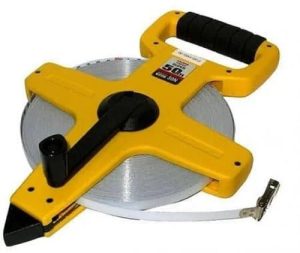
Advantages of Invar Tapes
- Exceptional accuracy due to minimal thermal expansion
- Ideal for high-precision measurements, particularly in baseline measurements
- Minimal need for temperature corrections in most conditions
- Suitable for scientific and geodetic surveys requiring utmost precision
- Maintain accuracy over a wide range of temperatures
- Essential for establishing precise control networks in large-scale surveys
Disadvantages of Invar Tapes
- Significantly more expensive than other types of tapes
- Softer and more easily deformed than steel tapes
- Develop creep over time, potentially affecting long-term accuracy
- Coefficient of thermal expansion may change over extended periods
- Require multiple assistants to handle and stretch properly
- Need very careful handling to avoid bending and kinking
- Not suitable for ordinary surveying work due to cost and handling requirements
- More challenging to repair or replace due to specialized material
- Require specialized storage and maintenance procedures
- Limited availability compared to other tape types
Invar tapes are highly specialized tools designed for the most demanding precision measurements in surveying and scientific applications. While they offer unparalleled accuracy in certain conditions, their use is generally limited to specific high-precision tasks due to their cost, handling requirements, and potential for deformation. They are typically used in establishing precise baselines for large-scale surveys, scientific research, and other applications where even minute measurement errors can have significant impacts.