Ashok Sapkota

Ashok Sapkota is a dedicated engineer currently serving at the Department of Water Resources and Irrigation in Nepal. With a strong educational background, Ashok completed his Bachelor's degree from the Institute of Engineering (IOE), Pulchowk Campus, Nepal. He is currently pursuing a Master's degree in Construction Management at the same prestigious institution.

Ashok's professional expertise lies in water resources and irrigation engineering, where he applies his knowledge to contribute to Nepal's water management and agricultural development.

Beyond his professional commitments, Ashok is passionate about sharing his engineering insights. He regularly writes blogs on various engineering topics, aiming to educate and inspire others in the field.

With a combination of practical experience, ongoing advanced education, and a drive to share knowledge, Ashok Sapkota represents the new generation of engineers working to shape Nepal's future.

The distance between two points, measured with a 20 m chain, was recorded as 327 m. It was afterwards found that the chain was 3 cm too long. What was the true distance between the points?

Problem Statement The distance between two points, measured with a 20 m chain, was recorded as 327 m. It was […]

The distance between two points, measured with a 20 m chain, was recorded as 327 m. It was afterwards found that the chain was 3 cm too long. What was the true distance between the points? Read More »

Two ranging rods, one of 3.00 m and the other of 1.50 m length, were used in the effort to find the height of an inaccessible tower. In the first setting the rods were so placed that their tops were in line with the top of the tower.

Two ranging rods, one of 3.00 m and the other of1.50 m length, were used in the effort to find the height of an in accessible tower. In the first setting the rods were so placed that their tops were inline with the top of the tower. The distance between the rods was 15 m .In the second setting the rods were ranged on the same line as before. This time the distance between the rods was 30 m. If the distance between the two longer rods was 90 m, find the height of the tower

Problem Statement Two ranging rods, one 3.00 m long and the other 1.50 m long, were used to determine the

Two ranging rods, one of 3.00 m and the other of1.50 m length, were used in the effort to find the height of an in accessible tower. In the first setting the rods were so placed that their tops were inline with the top of the tower. The distance between the rods was 15 m .In the second setting the rods were ranged on the same line as before. This time the distance between the rods was 30 m. If the distance between the two longer rods was 90 m, find the height of the tower Read More »

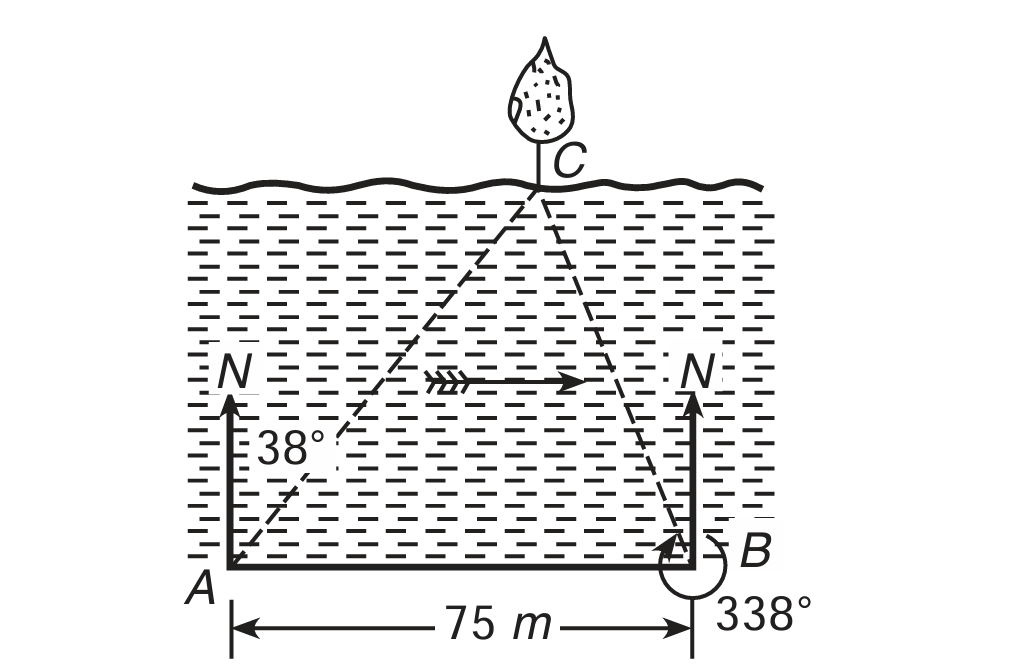
A river is flowing from west to east. For determining the width of the river two points A and B are selected on southern bank such that distance AB = 75 m. Point A is westwards. The bearings of a tree C on the northern bank are observed to be 38° and 338° respectively from A and B. Calculate the width of the river.

A river is flowing from west to east. For determining the width of the river two points A and B are selected on southern bank such that distance AB = 75 m. Point A is westwards. The bearings of a tree C on the northern bank are observed to be 38° and 338° respectively from A and B. Calculate the width of the river.

Problem Statement A river flows from west to east. To determine its width, two points, A and B, are selected

A river is flowing from west to east. For determining the width of the river two points A and B are selected on southern bank such that distance AB = 75 m. Point A is westwards. The bearings of a tree C on the northern bank are observed to be 38° and 338° respectively from A and B. Calculate the width of the river. Read More »

A big pond obstructs the chain line ab. A line al was measured on the left of line ab for circumventing the obstacle. The lengths al was 901 m. Similarly, another line am was measured on the right of line ab whose length was 1100 m. Points, m, b, and l are on the same straight line. Lengths of lines bl and bm are 502 m and 548 m respec tively. Find the distance ab.

A big pond obstructs the chain line ab. A line al was measured on the left of line ab for circumventing the obstacle. The lengths al was 901 m. Similarly, another line am was measured on the right of line ab whose length was 1100 m. Points, m, b, and l are on the same straight line. Lengths of lines bl and bm are 502 m and 548 m respectively. Find the distance ab.

Problem Statement A large pond obstructs the chain line AB. To circumvent the obstacle, a line AL was measured on

A big pond obstructs the chain line ab. A line al was measured on the left of line ab for circumventing the obstacle. The lengths al was 901 m. Similarly, another line am was measured on the right of line ab whose length was 1100 m. Points, m, b, and l are on the same straight line. Lengths of lines bl and bm are 502 m and 548 m respectively. Find the distance ab. Read More »

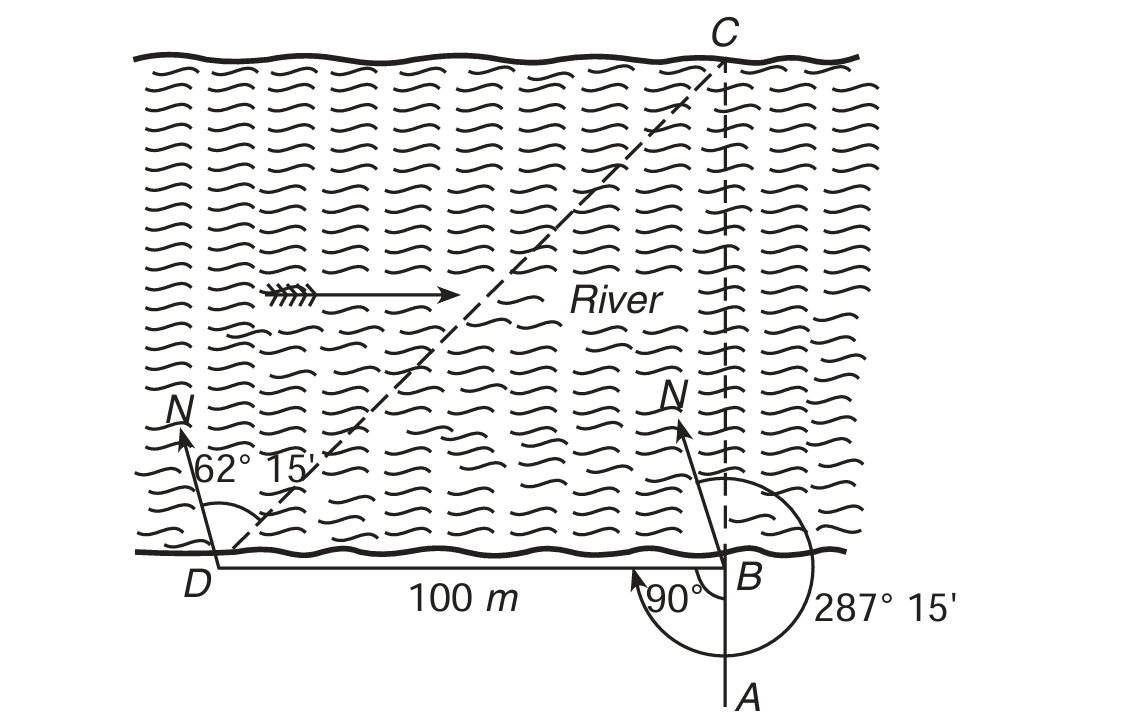
A chain line ABC crosses a river, B and C being on the near and distant banks respectively. A line BD of length 100 m is set out at right angles to the chain line at B. If the bearings of BD and DC are 287° 15′ and 62° 15′ respectively, find the width of the river.

A chain line ABC crosses a river, B and C being on the near and distant banks respectively. A line BD of length 100 m is set out at right angles to the chain line at B. If the bearings of BD and DC are 287° 15′ and 62° 15′ respectively, find the width of the river.

Problem Statement A chain line ABC crosses a river, B and C being on the near and distant banks respectively.

A chain line ABC crosses a river, B and C being on the near and distant banks respectively. A line BD of length 100 m is set out at right angles to the chain line at B. If the bearings of BD and DC are 287° 15′ and 62° 15′ respectively, find the width of the river. Read More »

A chain line PQR crosses a river, Q and R being on the near and distant banks respectively. A perpendicular QS, 90 m long, is set out at Q on the left of the chain line. The respective bearings of R and P taken at S are 77° 30′ 20′′ and 167° 30′ 20′′. Find the chainage of R given that PQ is 45 m and the chainage of Q is 650 m.

A chain line PQR crosses a river, Q and R being on the near and distant banks respectively. A perpendicular QS, 90 m long, is set out at Q on the left of the chain line. The respective bearings of R and P taken at S are 77° 30′ 20′′ and 167° 30′ 20′′. Find the chainage of R given that PQ is 45 m and the chainage of Q is 650 m.

Problem Statement A chain line PQR crosses a river, Q and R being on the near and distant banks respectively.

A chain line PQR crosses a river, Q and R being on the near and distant banks respectively. A perpendicular QS, 90 m long, is set out at Q on the left of the chain line. The respective bearings of R and P taken at S are 77° 30′ 20′′ and 167° 30′ 20′′. Find the chainage of R given that PQ is 45 m and the chainage of Q is 650 m. Read More »

A chain line PQR crosses a stream, Q and R being the near and far off banks respectively. A line QM of length 60 m is set out at right angles to the chain line at Q. If the bearings of QM and MR are 282° 45′ and 42° 45′ respectively, find the width of the stream.

A chain line PQR crosses a stream, Q and R being the near and far off banks respectively. A line QM of length 60 m is set out at right angles to the chain line at Q. If the bearings of QM and MR are 282° 45′ and 42° 45′ respectively, find the width of the stream.

Problem Statement A chain line PQR crosses a stream, Q and R being the near and far off banks respectively.

A chain line PQR crosses a stream, Q and R being the near and far off banks respectively. A line QM of length 60 m is set out at right angles to the chain line at Q. If the bearings of QM and MR are 282° 45′ and 42° 45′ respectively, find the width of the stream. Read More »

A survey line CDE crosses a river, D being on the near bank, and E on the opposite bank. A perpendicular DF = 150 metres is ranged at D on the left. From F bearings of E and C are observed to be 25o and 115o respectively. If the chainage of C is 1250 metres and that of D is 1620 metres, find the chainage of E.

A survey line CDE crosses a river, D being on the near bank, and E on the opposite bank. A perpendicular DF = 150 metres is ranged at D on the left. From F bearings of E and C are observed to be 25° and 115° respectively. If the chainage of C is 1250 meters and that of D is 1620 metres, find the chainage of E.

Problem Statement A survey line CDE crosses a river, D being on the near bank, and E on the opposite

A survey line CDE crosses a river, D being on the near bank, and E on the opposite bank. A perpendicular DF = 150 metres is ranged at D on the left. From F bearings of E and C are observed to be 25° and 115° respectively. If the chainage of C is 1250 meters and that of D is 1620 metres, find the chainage of E. Read More »

A survey line BAC crosses a river; A and C being the near and far banks respectively. A perpendicular AD, 40 metres long is set out at A. If the bearings of AD and DC are 38o 45′ and 278o 45′ respectively, find the width of the river.

A survey line BAC crosses a river A and C being the near and far banks respectively. A perpendicular AD, 40 meters long is set out at A. If the bearings of AD and DC are 38° 45′ and 278° 45′ respectively, find the width of the river.

Problem Statement A survey line BAC crosses a river; A and C being the near and far banks respectively. A

A survey line BAC crosses a river A and C being the near and far banks respectively. A perpendicular AD, 40 meters long is set out at A. If the bearings of AD and DC are 38° 45′ and 278° 45′ respectively, find the width of the river. Read More »

Find the maximum permissible error in laying off the direction of an offset so that maximum displacement may not exceed 0.025 cm on paper given that length of the offset is 15 m, the scale is 1cm to 50 cm and the maximum error in length of the offset is 0.5 m.

Problem Statement Find the maximum permissible error in laying off the direction of an offset so that maximum displacement may

Find the maximum permissible error in laying off the direction of an offset so that maximum displacement may not exceed 0.025 cm on paper given that length of the offset is 15 m, the scale is 1cm to 50 cm and the maximum error in length of the offset is 0.5 m. Read More »

Find the maximum length of an offset so that the displacement on paper from both sources of error should not exceed 0.025 cm. Given that the offset is measured with an accuracy of 1 in 25, and the scale is 1 cm = 30 m.

Surveying Max Offset Length Calculation Surveying Problem: Maximum Offset Length Problem: Find the maximum length of an offset so that

Find the maximum length of an offset so that the displacement on paper from both sources of error should not exceed 0.025 cm. Given that the offset is measured with an accuracy of 1 in 25, and the scale is 1 cm = 30 m. Read More »

With what accuracy should an offset be measured if the angular error in laying off the perpendicular direction is 5°, so that the maximum displacement of the point on paper is the same due to these two sources of error?

Surveying Offset Accuracy Calculation Surveying Problem: Required Offset Measurement Accuracy Problem: With what accuracy should an offset be measured if

With what accuracy should an offset be measured if the angular error in laying off the perpendicular direction is 5°, so that the maximum displacement of the point on paper is the same due to these two sources of error? Read More »

Scroll to Top