Ashok Sapkota

Ashok Sapkota is a dedicated engineer currently serving at the Department of Water Resources and Irrigation in Nepal. With a strong educational background, Ashok completed his Bachelor's degree from the Institute of Engineering (IOE), Pulchowk Campus, Nepal. He is currently pursuing a Master's degree in Construction Management at the same prestigious institution.

Ashok's professional expertise lies in water resources and irrigation engineering, where he applies his knowledge to contribute to Nepal's water management and agricultural development.

Beyond his professional commitments, Ashok is passionate about sharing his engineering insights. He regularly writes blogs on various engineering topics, aiming to educate and inspire others in the field.

With a combination of practical experience, ongoing advanced education, and a drive to share knowledge, Ashok Sapkota represents the new generation of engineers working to shape Nepal's future.

A 0.4mx0.3m, 900 vertical bend carries 0.6m3/s oil of sp gr 0.8 with a pressure of 120 Kpa at inlet to the bend. The volume of the bend is 0.1 m3. Find the magnitude and direction of the force on the bend. Neglect friction and assume both inlet and outlet sections to be at same horizontal level. Also assume that water enters the bend at 450 to the horizontal.

A 0.4m×0.3m, 90° vertical bend carries 0.6m³/s oil of specific gravity 0.8 with a pressure of 120 kPa at inlet to the bend. The volume of the bend is 0.1 m³. Find the magnitude and direction of the force on the bend. Neglect friction and assume both inlet and outlet sections to be at same horizontal level. Also assume that water enters the bend at 45° to the horizontal.

Fluid Mechanics Problem Solution Problem Statement A 0.4m×0.3m, 90° vertical bend carries 0.6m³/s oil of specific gravity 0.8 with a […]

A 0.4m×0.3m, 90° vertical bend carries 0.6m³/s oil of specific gravity 0.8 with a pressure of 120 kPa at inlet to the bend. The volume of the bend is 0.1 m³. Find the magnitude and direction of the force on the bend. Neglect friction and assume both inlet and outlet sections to be at same horizontal level. Also assume that water enters the bend at 45° to the horizontal. Read More »

. The angle of a reducing bend is 600. Its initial diameter is 300mm and final diameter is 150mm and is lifted in a pipeline carrying water at a rate of 330 lps. The pressure at the commencement of the bend is 3.1 bar. The friction loss in the pipe may be assumed as 10% of kinetic energy at the exit of the bend. Determine the force exerted by the reducing bend.

A reducing bend with an angle of 60° is installed in a pipeline carrying water. The initial diameter is 300 mm and the final diameter is 150 mm. Water flows at a rate of 330 lps and the pressure at the commencement of the bend is 3.1 bar. The friction loss in the pipe is assumed as 10% of the kinetic energy at the exit of the bend. Determine the force exerted by the reducing bend.

Reducing Bend Problem Solution Problem Statement A reducing bend with an angle of 60° is installed in a pipeline carrying

A reducing bend with an angle of 60° is installed in a pipeline carrying water. The initial diameter is 300 mm and the final diameter is 150 mm. Water flows at a rate of 330 lps and the pressure at the commencement of the bend is 3.1 bar. The friction loss in the pipe is assumed as 10% of the kinetic energy at the exit of the bend. Determine the force exerted by the reducing bend. Read More »

A 450 reducing bend is connected in a pipe line carrying water. The diameter at inlet and outlet of the bend is 400mm and 200mm respectively. Find the force exerted by water on the bend if the intensity of pressure at inlet of the bend is 215.8KN/m2. The rate of flow of water is 0.5m3/s. The loss of head in the bend is 1.25m of oil of sp.gr. 0.85.

A 45° reducing bend is connected in a pipeline carrying water. The diameter at the inlet and outlet of the bend is 400 mm and 200 mm respectively. Find the force exerted by water on the bend if the intensity of pressure at the inlet is 215.8 kN/m², the rate of flow is 0.5 m³/s, and the loss of head in the bend is 1.25 m of oil (specific gravity 0.85).

Reducing Bend Problem Solution Problem Statement A 45° reducing bend is connected in a pipeline carrying water. The diameter at

A 45° reducing bend is connected in a pipeline carrying water. The diameter at the inlet and outlet of the bend is 400 mm and 200 mm respectively. Find the force exerted by water on the bend if the intensity of pressure at the inlet is 215.8 kN/m², the rate of flow is 0.5 m³/s, and the loss of head in the bend is 1.25 m of oil (specific gravity 0.85). Read More »

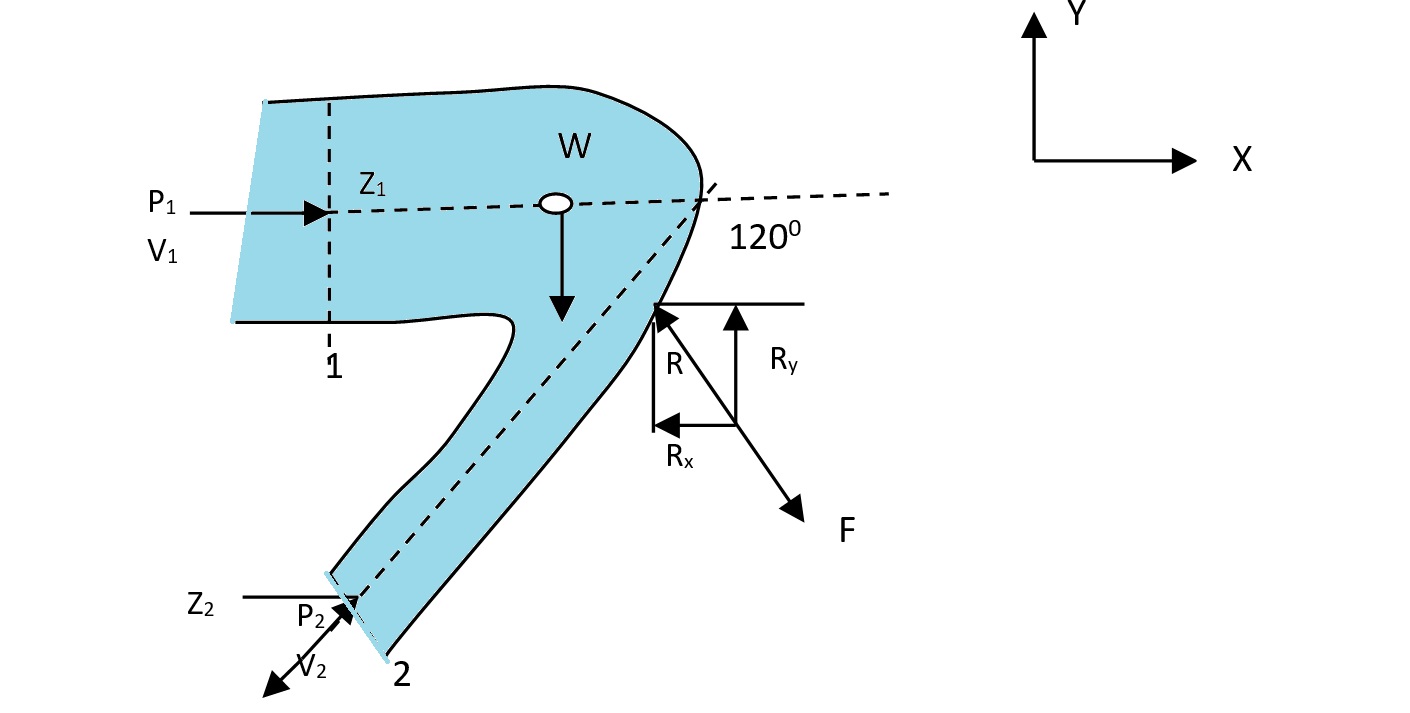
The diameter of a pipe bend is 30cm at inlet and 15cm at outlet and the flow is turned through 1200 in a vertical plane. The axis at inlet is horizontal and the center of the outlet section is 1.5m below the center of the inlet section. Total volume of water in the bend is 0.9m3. Neglecting friction, calculate the magnitude and direction of the force exerted on the bend by water flowing through it at 250lps and when the inlet pressure is 0.15N/mm2.

The diameter of a pipe bend is 30cm at inlet and 15cm at outlet, and the flow is turned through 120° in a vertical plane. The axis at inlet is horizontal and the center of the outlet section is 1.5m below the center of the inlet section. Total volume of water in the bend is 0.9m³. Neglecting friction, calculate the magnitude and direction of the force exerted on the bend by water flowing through it at 250lps and when the inlet pressure is 0.15N/mm².

Fluid Mechanics Problem Solution Problem Statement The diameter of a pipe bend is 30cm at inlet and 15cm at outlet,

The diameter of a pipe bend is 30cm at inlet and 15cm at outlet, and the flow is turned through 120° in a vertical plane. The axis at inlet is horizontal and the center of the outlet section is 1.5m below the center of the inlet section. Total volume of water in the bend is 0.9m³. Neglecting friction, calculate the magnitude and direction of the force exerted on the bend by water flowing through it at 250lps and when the inlet pressure is 0.15N/mm². Read More »

Determine the magnitude of resultant force and its direction on the vane shown in the figure below if a water of jet 50mm diameter and 20m/s velocity strikes the vane tangentially and deflects without friction.

Determine the magnitude of resultant force and its direction on the vane shown in the figure below if a water jet of 50mm diameter and 20m/s velocity strikes the vane tangentially and deflects without friction.

Pipe Bend Force Calculation – Fluid Mechanics Solution Water Jet Impact on Vane Fluid Mechanics Problem Solution Problem Statement Determine

Determine the magnitude of resultant force and its direction on the vane shown in the figure below if a water jet of 50mm diameter and 20m/s velocity strikes the vane tangentially and deflects without friction. Read More »

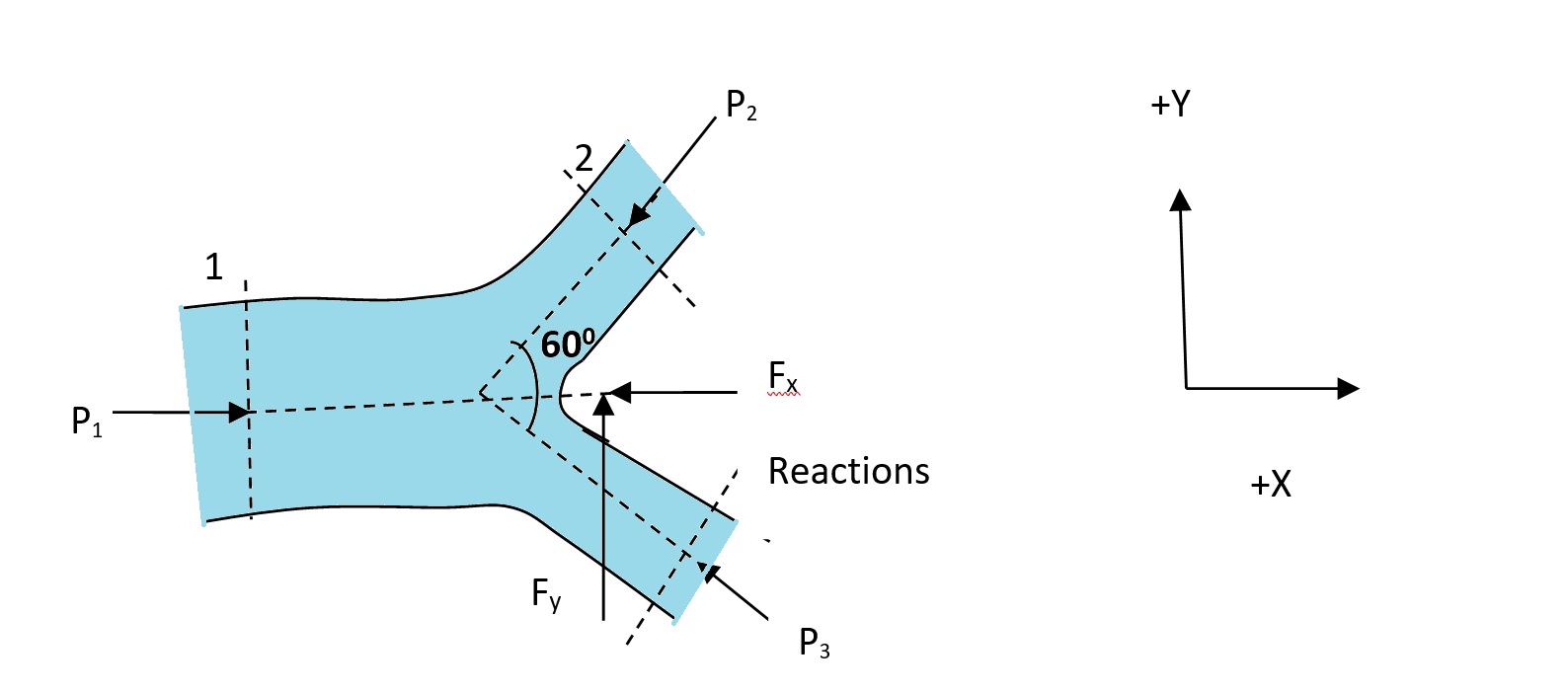
A main pipe of diameter 500mm branches in two pipes of diameter 300mm each in the horizontal plane. Angle between the branches is 600, which is symmetrical with respect to the main pipe. Flow discharge through the main pipe is 1.0 m3/s, which is equally divided into the branch pipes. If the pressure intensity at the main pipe is 400KPa, find the magnitude and direction of resultant force in the bend. Assume no loss of energy due to branch junction and in pipe sections.

A main pipe of diameter 500mm branches in two pipes of diameter 300mm each in the horizontal plane. Angle between the branches is 60°, which is symmetrical with respect to the main pipe. Flow discharge through the main pipe is 1.0 m³/s, which is equally divided into the branch pipes. If the pressure intensity at the main pipe is 400 kPa, find the magnitude and direction of resultant force in the bend. Assume no loss of energy due to branch junction and in pipe sections.

Pipe Branch Force Calculation – Fluid Mechanics Solution Pipe Branch Force Calculation Fluid Mechanics Problem Solution Problem Statement A main

A main pipe of diameter 500mm branches in two pipes of diameter 300mm each in the horizontal plane. Angle between the branches is 60°, which is symmetrical with respect to the main pipe. Flow discharge through the main pipe is 1.0 m³/s, which is equally divided into the branch pipes. If the pressure intensity at the main pipe is 400 kPa, find the magnitude and direction of resultant force in the bend. Assume no loss of energy due to branch junction and in pipe sections. Read More »

A 150mm diameter pipe on the horizontal plane carries water under the head of 16m of water with the velocity of 3.5 m/s. Find the direction and magnitude of the pipe bend, if the axis of the bend was turned with angle 750. Assume no loss of energy at the pipe bend.

A 150mm diameter pipe on the horizontal plane carries water under the head of 16m of water with the velocity of 3.5 m/s. Find the direction and magnitude of the pipe bend, if the axis of the bend was turned with angle 75°. Assume no loss of energy at the pipe bend.

Pipe Bend Force Calculation – Fluid Mechanics Solution Pipe Bend Force Calculation Fluid Mechanics Problem Solution Problem Statement A 150mm

A 150mm diameter pipe on the horizontal plane carries water under the head of 16m of water with the velocity of 3.5 m/s. Find the direction and magnitude of the pipe bend, if the axis of the bend was turned with angle 75°. Assume no loss of energy at the pipe bend. Read More »

A 450 pipe bend tapers from 600mm diameter at inlet to 300mm diameter at outlet. The pressure at inlet is 140KN/m2 and the rate of flow is 0.425m3/s. At outlet the pressure is 123KN/m2 gauge. Neglecting friction, calculate the resultant force exerted by the water on the bend in magnitude and direction. The bend lies in a horizontal plane.

A 45° pipe bend tapers from 600mm diameter at inlet to 300mm diameter at outlet. The pressure at inlet is 140 kN/m² and the rate of flow is 0.425 m³/s. At outlet the pressure is 123 kN/m² gauge. Neglecting friction, calculate the resultant force exerted by the water on the bend in magnitude and direction. The bend lies in a horizontal plane.

Pipe Bend Force Calculation – Fluid Mechanics Solution Pipe Bend Force Calculation Fluid Mechanics Problem Solution Problem Statement A 45°

A 45° pipe bend tapers from 600mm diameter at inlet to 300mm diameter at outlet. The pressure at inlet is 140 kN/m² and the rate of flow is 0.425 m³/s. At outlet the pressure is 123 kN/m² gauge. Neglecting friction, calculate the resultant force exerted by the water on the bend in magnitude and direction. The bend lies in a horizontal plane. Read More »

The discharge of water through a 1300 bend is 30 litres/s. The bend is lying in the horizontal plane and the diameters at the entrance and exit are 200mm and 100mm respectively. The pressure measured at the entrance is 100 kN/m2, what is the magnitude and direction of the force exerted by the water on the bend?

The discharge of water through a 130° bend is 30 litres/s. The bend is lying in the horizontal plane and the diameters at the entrance and exit are 200mm and 100mm respectively. The pressure measured at the entrance is 100 kN/m². What is the magnitude and direction of the force exerted by the water on the bend?

Pipe Bend Force Calculation – Fluid Mechanics Solution Pipe Bend Force Calculation Fluid Mechanics Problem Solution Problem Statement The discharge

The discharge of water through a 130° bend is 30 litres/s. The bend is lying in the horizontal plane and the diameters at the entrance and exit are 200mm and 100mm respectively. The pressure measured at the entrance is 100 kN/m². What is the magnitude and direction of the force exerted by the water on the bend? Read More »

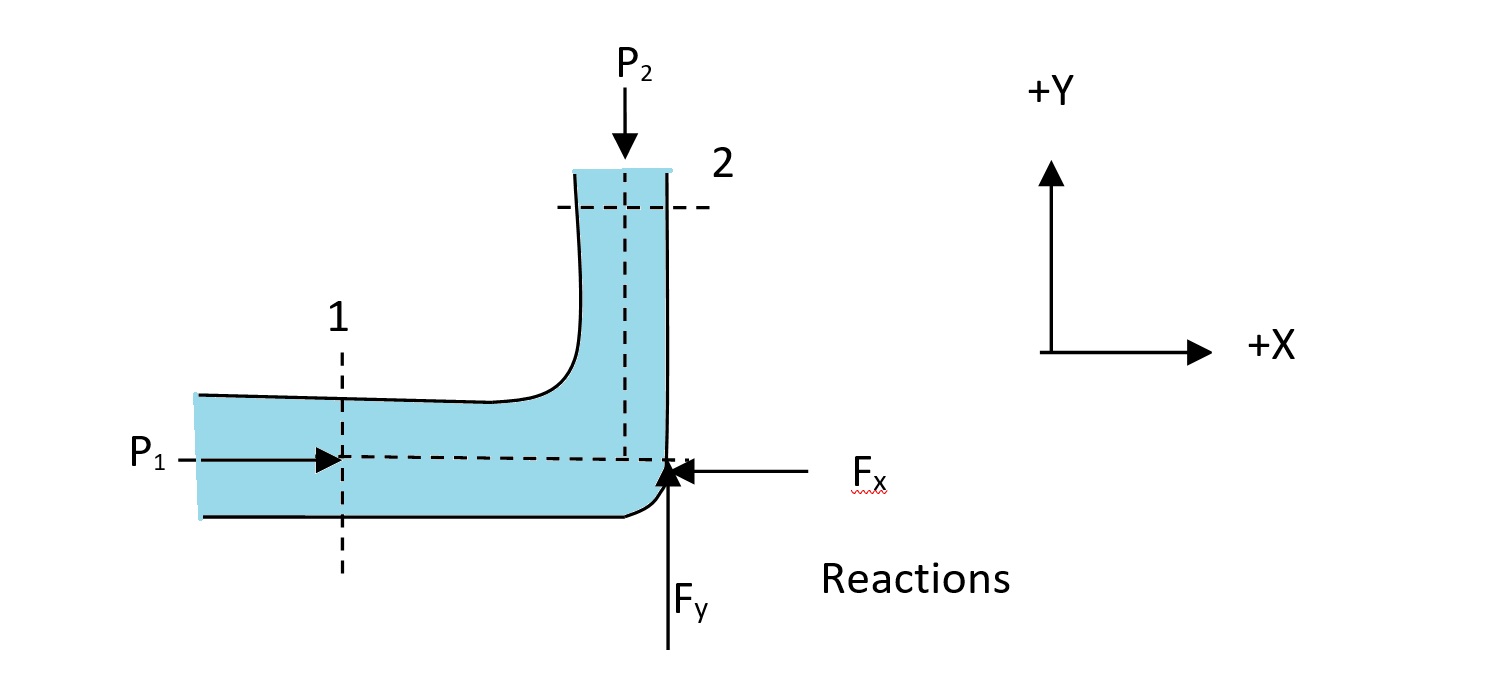
A 500mm pipe carrying 0.8 m3/s of oil (sp gr 0.85) has a 900 bend in a horizontal plane. The loss of head in the bend is 1.1m of oil, and the pressure at the entrance is 290KPa. Determine the resultant force exerted by the oil on the bend.

A 500mm pipe carrying 0.8 m3/s of oil (sp gr 0.85) has a 900 bend in a horizontal plane. The loss of head in the bend is 1.1m of oil, and the pressure at the entrance is 290KPa. Determine the resultant force exerted by the oil on the bend.

Pipe Bend Force Calculation – Fluid Mechanics Solution Pipe Bend Force Calculation Fluid Mechanics Problem Solution Problem Statement A 500mm

A 500mm pipe carrying 0.8 m3/s of oil (sp gr 0.85) has a 900 bend in a horizontal plane. The loss of head in the bend is 1.1m of oil, and the pressure at the entrance is 290KPa. Determine the resultant force exerted by the oil on the bend. Read More »

A 60cm pipe is connected to a 30cm pipe by a standard reducer fitting. For the same flow of 0.9 m3/s of water and a pressure of 200Kpa, what force is exerted by the water on the reducer, neglecting any lost head?

A 60cm pipe is connected to a 30cm pipe by a standard reducer fitting. For the same flow of 0.9 m3/s of water and a pressure of 200Kpa, what force is exerted by the water on the reducer, neglecting any lost head?

Pipe Reducer Force Calculation – Fluid Mechanics Solution Pipe Reducer Force Calculation Fluid Mechanics Problem Solution Problem Statement A 60cm

A 60cm pipe is connected to a 30cm pipe by a standard reducer fitting. For the same flow of 0.9 m3/s of water and a pressure of 200Kpa, what force is exerted by the water on the reducer, neglecting any lost head? Read More »

A tank is in the form of hemisphere of 2m diameter and having a cylindrical upper part of 2m diameter and 3m height. Find the time of emptying the tank through an orifice of 75mm diameter at its bottom if the tank is initially full of water. Take Cd = 0.62.

A tank is in the form of hemisphere of 2m diameter and having a cylindrical upper part of 2m diameter and 3m height. Find the time of emptying the tank through an orifice of 75mm diameter at its bottom if the tank is initially full of water. Take Cd = 0.62.

Hemispherical-Cylindrical Tank Emptying – Fluid Mechanics Solution Hemispherical-Cylindrical Tank Emptying Fluid Mechanics Problem Solution Problem Statement A tank is in

A tank is in the form of hemisphere of 2m diameter and having a cylindrical upper part of 2m diameter and 3m height. Find the time of emptying the tank through an orifice of 75mm diameter at its bottom if the tank is initially full of water. Take Cd = 0.62. Read More »

Scroll to Top