Ashok Sapkota

Ashok Sapkota is a dedicated engineer currently serving at the Department of Water Resources and Irrigation in Nepal. With a strong educational background, Ashok completed his Bachelor's degree from the Institute of Engineering (IOE), Pulchowk Campus, Nepal. He is currently pursuing a Master's degree in Construction Management at the same prestigious institution.

Ashok's professional expertise lies in water resources and irrigation engineering, where he applies his knowledge to contribute to Nepal's water management and agricultural development.

Beyond his professional commitments, Ashok is passionate about sharing his engineering insights. He regularly writes blogs on various engineering topics, aiming to educate and inspire others in the field.

With a combination of practical experience, ongoing advanced education, and a drive to share knowledge, Ashok Sapkota represents the new generation of engineers working to shape Nepal's future.

A kite weighs 0.9N and has an area of 7400 cm2. The tension in the kite string is 3.3 N when the string makes an angle of 450 with the horizontal. For a wind of 30km/hr, what are the coefficients of lift and drag if the kite assumes an angle of 80 with the horizontal? Consider the kite essentially a flat plate and density of air = 1.2kg/m3.

A kite weighs 0.9N and has an area of 7400 cm². The tension in the kite string is 3.3 N when the string makes an angle of 45° with the horizontal. For a wind of 30km/hr, what are the coefficients of lift and drag if the kite assumes an angle of 8° with the horizontal? Consider the kite essentially a flat plate and density of air = 1.2kg/m³.

Fluid Mechanics Problem Solution Problem Statement A kite weighs 0.9N and has an area of 7400 cm². The tension in […]

A kite weighs 0.9N and has an area of 7400 cm². The tension in the kite string is 3.3 N when the string makes an angle of 45° with the horizontal. For a wind of 30km/hr, what are the coefficients of lift and drag if the kite assumes an angle of 8° with the horizontal? Consider the kite essentially a flat plate and density of air = 1.2kg/m³. Read More »

A flat plate 2m×2m moves at 40km/hr in stationary air of density 1.25kg/m³. If the coefficient of drag and lift are 0.2 and 0.8 respectively, find the lift force, the drag force, the resultant force and the power required to keep the plate in motion.

Fluid Mechanics Problem Solution Problem Statement A flat plate 2m×2m moves at 40km/hr in stationary air of density 1.25kg/m³. If

A flat plate 2m×2m moves at 40km/hr in stationary air of density 1.25kg/m³. If the coefficient of drag and lift are 0.2 and 0.8 respectively, find the lift force, the drag force, the resultant force and the power required to keep the plate in motion. Read More »

For the velocity profile given below, compute the displacement thickness and momentum thickness: u/U=3/2 (y/δ)-1/2 (y/δ)^2 Where U = free stream velocity, u = velocity in boundary layer at a distance y and δ= boundary layer thickness.

For the velocity profile given below, compute the displacement thickness and momentum thickness: u/U = 3/2 (y/δ) – 1/2 (y/δ)² Where U = free stream velocity, u = velocity in boundary layer at a distance y and δ = boundary layer thickness.

Fluid Mechanics Problem Solution Problem Statement For the velocity profile given below, compute the displacement thickness and momentum thickness: u/U

For the velocity profile given below, compute the displacement thickness and momentum thickness: u/U = 3/2 (y/δ) – 1/2 (y/δ)² Where U = free stream velocity, u = velocity in boundary layer at a distance y and δ = boundary layer thickness. Read More »

A flat plate of 2m width and 4m length is kept parallel to air flowing at 5m/s. Determine the length of plate over which the boundary layer is laminar and shear stress at the location where boundary layer ceases to be laminar. Take ρ of air = 1.208 kg/m³ and υ of air = 1.47×10⁻⁵ m²/s.

Fluid Mechanics Problem Solution Problem Statement A flat plate of 2m width and 4m length is kept parallel to air

A flat plate of 2m width and 4m length is kept parallel to air flowing at 5m/s. Determine the length of plate over which the boundary layer is laminar and shear stress at the location where boundary layer ceases to be laminar. Take ρ of air = 1.208 kg/m³ and υ of air = 1.47×10⁻⁵ m²/s. Read More »

If the velocity distribution law in a laminar boundary layer over a flat plate is assumed to be of the form u = ay + by³, determine the velocity distribution law.

Fluid Mechanics Problem Solution Problem Statement If the velocity distribution law in a laminar boundary layer over a flat plate

If the velocity distribution law in a laminar boundary layer over a flat plate is assumed to be of the form u = ay + by³, determine the velocity distribution law. Read More »

A jet of 20mm in diameter moving with a velocity of 5m/s strikes a smooth plate, which is inclined at an angle of 200 to the horizontal. Compute the amount of flow on each side of the plate and the force exerted on the plate.

A water jet of 20mm diameter moving with a velocity of 5m/s strikes a fixed plate at an angle of 20° to the horizontal. Compute the amount of flow on each side of the plate and the force exerted on the plate.

Fluid Mechanics Problem Solution Problem Statement A water jet of 20mm diameter moving with a velocity of 5m/s strikes a

A water jet of 20mm diameter moving with a velocity of 5m/s strikes a fixed plate at an angle of 20° to the horizontal. Compute the amount of flow on each side of the plate and the force exerted on the plate. Read More »

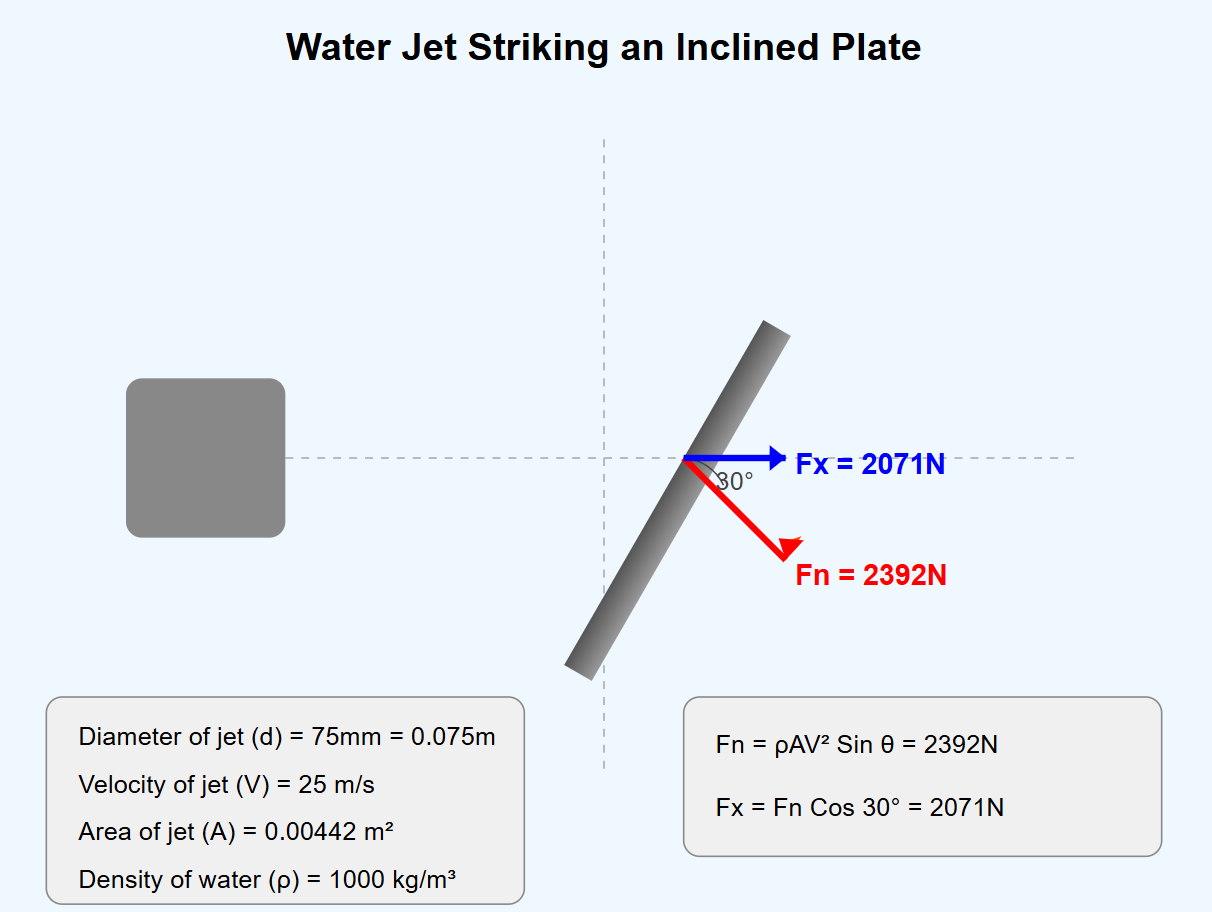
A 75mm diameter jet of water having a velocity of 25m/s strikes a flat plate, the normal of which is inclined at 300 to the jet. Find the force normal to the surface of the plate and in the direction of the jet.

A 75mm diameter jet of water having a velocity of 25m/s strikes a flat plate, the normal of which is inclined at 300 to the jet. Find the force normal to the surface of the plate and in the direction of the jet.

Fluid Mechanics Problem Solution Problem Statement A 75mm diameter jet of water having a velocity of 25m/s strikes a flat

A 75mm diameter jet of water having a velocity of 25m/s strikes a flat plate, the normal of which is inclined at 300 to the jet. Find the force normal to the surface of the plate and in the direction of the jet. Read More »

A jet of water 60 mm in diameter with a velocity of 15m/s strikes a flat plate inclined at an angle of 250 to the axis of the jet. Calculate the normal force exerted on the plate (a) when the plate is stationary, (b) when the plate is moving at 4.5 m/s in the direction of jet and (c) the work done per sec and the efficiency for case b.

A jet of water 60 mm in diameter with a velocity of 15m/s strikes a flat plate inclined at an angle of 250 to the axis of the jet. Calculate the normal force exerted on the plate (a) when the plate is stationary, (b) when the plate is moving at 4.5 m/s in the direction of jet and (c) the work done per sec and the efficiency for case b.

Fluid Mechanics Problem Solution Problem Statement A jet of water 60 mm in diameter with a velocity of 15 m/s

A jet of water 60 mm in diameter with a velocity of 15m/s strikes a flat plate inclined at an angle of 250 to the axis of the jet. Calculate the normal force exerted on the plate (a) when the plate is stationary, (b) when the plate is moving at 4.5 m/s in the direction of jet and (c) the work done per sec and the efficiency for case b. Read More »

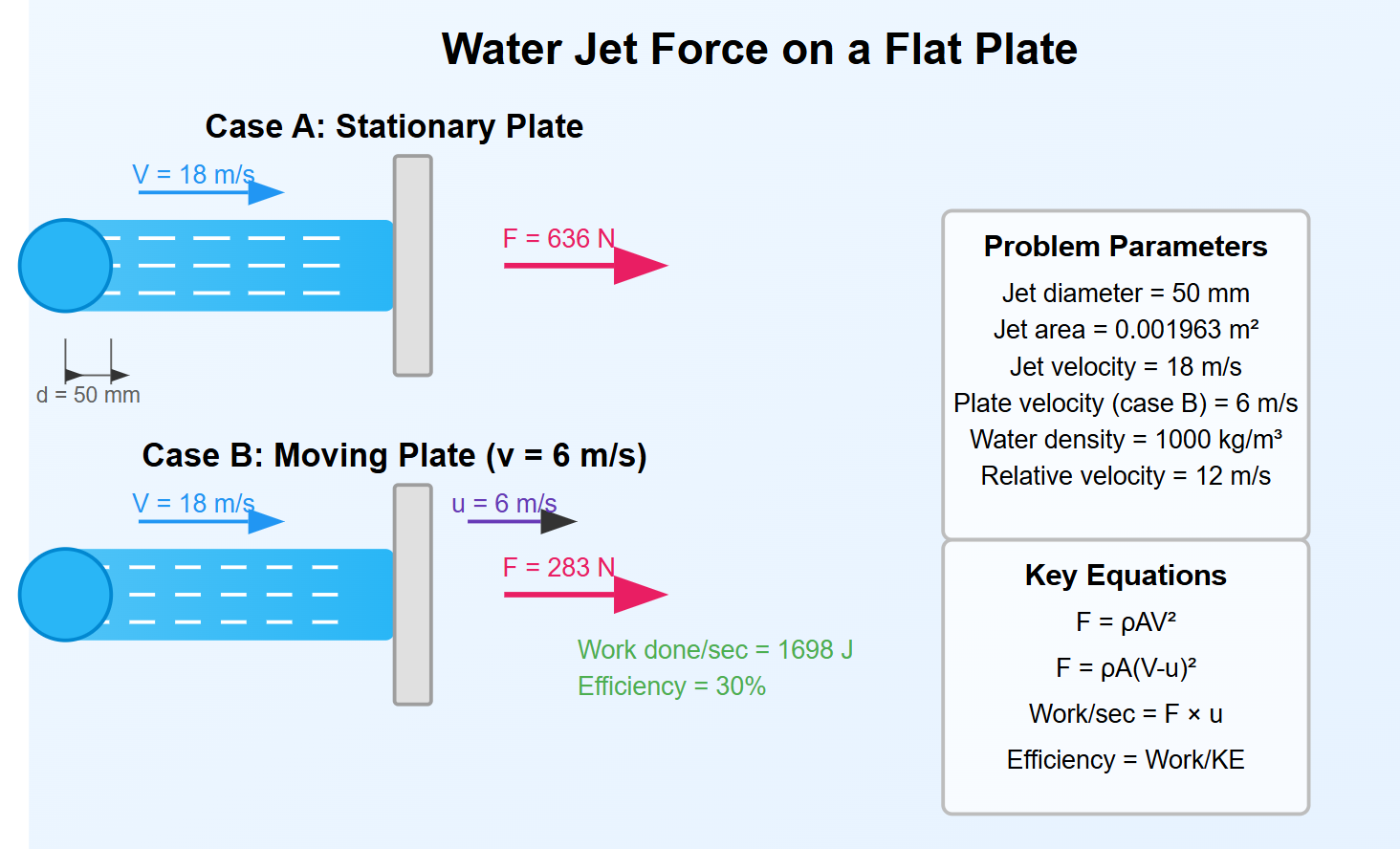
. A flat plate is struck normally by a jet of water 50mm in diameter with a velocity of 18m/s. Calculate: a) the force on the plate when it is stationary, b) the force on the plate when it moves in the same direction as the jet with a velocity of 6m/s, and c) the work done per sec and the efficiency in case (b).

A flat plate is struck normally by a jet of water 50mm in diameter with a velocity of 18m/s. Calculate: a) the force on the plate when it is stationary, b) the force on the plate when it moves in the same direction as the jet with a velocity of 6m/s, and c) the work done per sec and the efficiency in case (b).

Fluid Mechanics Problem Solution Problem Statement A flat plate is struck normally by a jet of water 50mm in diameter

A flat plate is struck normally by a jet of water 50mm in diameter with a velocity of 18m/s. Calculate: a) the force on the plate when it is stationary, b) the force on the plate when it moves in the same direction as the jet with a velocity of 6m/s, and c) the work done per sec and the efficiency in case (b). Read More »

A lawn sprinkler with two nozzles 5mm in diameter each at 0.2m and 0.15m radii is connected across a tap capable of discharging 6 litres/min. The nozzles discharge water upwards and outwards from the plane of rotation. What torque will sprinkler exert on the hand if held stationary, and at what angular velocity will it rotate free?

A lawn sprinkler with two nozzles 5mm in diameter each at 0.2m and 0.15m radii is connected across a tap capable of discharging 6 litres/min. The nozzles discharge water upwards and outwards from the plane of rotation. What torque will sprinkler exert on the hand if held stationary, and at what angular velocity will it rotate free?

Fluid Mechanics Problem Solution Problem Statement A lawn sprinkler with two nozzles 5mm in diameter each at 0.2m and 0.15m

A lawn sprinkler with two nozzles 5mm in diameter each at 0.2m and 0.15m radii is connected across a tap capable of discharging 6 litres/min. The nozzles discharge water upwards and outwards from the plane of rotation. What torque will sprinkler exert on the hand if held stationary, and at what angular velocity will it rotate free? Read More »

A lawn sprinkler shown in the figure has 0.8cm diameter nozzle at the end of a rotating arm and discharges water at the rate of 12m/s. Determine the torque required to hold the rotating arm stationary. Also determine the constant speed of rotation of the arm, if free to rotate.

A lawn sprinkler shown in the figure has 0.8cm diameter nozzle at the end of a rotating arm and discharges water at the rate of 12m/s. Determine the torque required to hold the rotating arm stationary. Also determine the constant speed of rotation of the arm, if free to rotate.

Fluid Mechanics Problem Solution Problem Statement A lawn sprinkler shown in the figure has 0.8cm diameter nozzle at the end

A lawn sprinkler shown in the figure has 0.8cm diameter nozzle at the end of a rotating arm and discharges water at the rate of 12m/s. Determine the torque required to hold the rotating arm stationary. Also determine the constant speed of rotation of the arm, if free to rotate. Read More »

The lawn sprinkler shown below has nozzles of 5mm diameter and carries a total discharge of 0.20 lps. Determine the angular speed of rotation of the sprinkler and torque required to hold the sprinkler stationary. Assume no friction at the pivot.

The lawn sprinkler shown below has nozzles of 5mm diameter and carries a total discharge of 0.20 lps. Determine the angular speed of rotation of the sprinkler and torque required to hold the sprinkler stationary. Assume no friction at the pivot.

Fluid Mechanics Problem Solution Problem Statement The lawn sprinkler shown below has nozzles of 5mm diameter and carries a total

The lawn sprinkler shown below has nozzles of 5mm diameter and carries a total discharge of 0.20 lps. Determine the angular speed of rotation of the sprinkler and torque required to hold the sprinkler stationary. Assume no friction at the pivot. Read More »

Scroll to Top