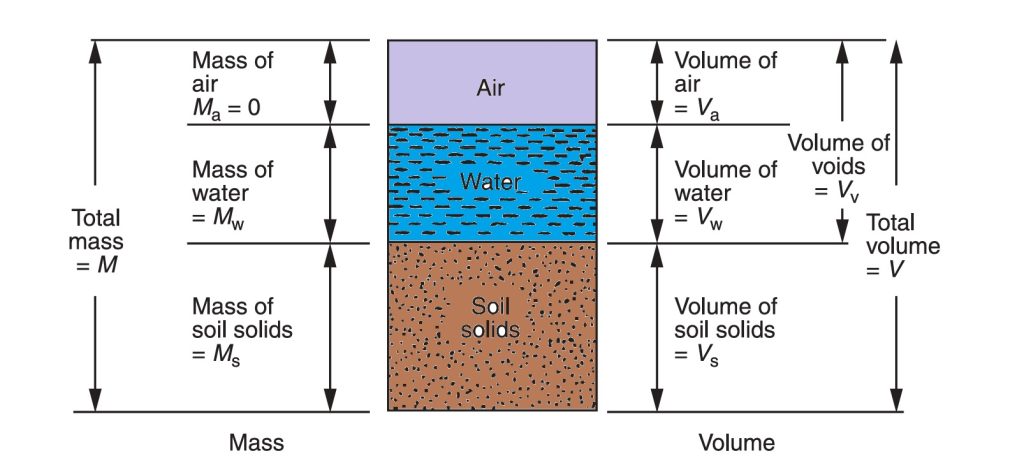
Problem Statement (GATE Exam 1998)
The total unit weight of the glacial outwash soil is 16 kN/m³. The specific gravity of soil particles is 2.67, and the water content of the soil is 17%. Calculate:
- Dry unit weight (\( \gamma_d \))
- Porosity (\( n \))
- Void ratio (\( e \))
- Degree of saturation (\( S \))
Solution
1. Given Data
- Total unit weight (\( \gamma \)) = 16 kN/m³
- Specific gravity (\( G \)) = 2.67
- Water content (\( w \)) = 17% = 0.17
- Unit weight of water (\( \gamma_w \)) = 9.81 kN/m³
2. Calculate Dry Unit Weight (\( \gamma_d \))
\( \gamma_d = \frac{\gamma}{1 + w} = \frac{16}{1 + 0.17} = \frac{16}{1.17} = 13.675 \, \text{kN/m³} \)
3. Calculate Void Ratio (\( e \))
\( e = \frac{G \cdot \gamma_w}{\gamma_d} – 1 \)
Substituting values: \( e = \frac{2.67 \cdot 9.81}{13.675} – 1 = \frac{26.2}{13.675} – 1 = 0.9153 \)
4. Calculate Porosity (\( n \))
\( n = \frac{e}{1 + e} = \frac{0.9153}{1 + 0.9153} = \frac{0.9153}{1.9153} = 0.4779 \times 100 = 47.79\% \)
5. Calculate Degree of Saturation (\( S \))
\( S = \frac{w \cdot G}{e} = \frac{0.17 \cdot 2.67}{0.9153} = \frac{0.4539}{0.9153} = 0.4959 \times 100 = 49.59\% \)
Results:
- Dry unit weight (\( \gamma_d \)) = 13.675 kN/m³
- Porosity (\( n \)) = 47.79%
- Void ratio (\( e \)) = 0.9153
- Degree of saturation (\( S \)) = 49.59%
Explanation
Key Steps:
- Dry Unit Weight: Calculated to remove the influence of water content and represents the weight of solids per unit volume.
- Void Ratio: Measures the volume of voids relative to the volume of solids, calculated using the dry unit weight, specific gravity, and unit weight of water.
- Porosity: Indicates the proportion of the total volume occupied by voids, derived from the void ratio.
- Degree of Saturation: Represents the fraction of voids filled with water, derived using water content, specific gravity, and void ratio.
Physical Meaning
1. Dry Unit Weight (13.675 kN/m³):
- Represents the density of the soil in a completely dry state, essential for analyzing soil stability and compaction.
2. Void Ratio (0.9153):
- A high void ratio indicates the soil is loosely packed, which could impact its strength and compressibility.
3. Porosity (47.79%):
- Almost half of the soil volume consists of voids, which influences its permeability and storage capacity.
4. Degree of Saturation (49.59%):
- Indicates that about half of the voids are filled with water, affecting the soil’s capillarity and suction potential.
Engineering Significance:
- The dry unit weight helps in compaction tests to achieve desired soil strength.
- The void ratio and porosity provide insights into the soil’s compactness and drainage properties.
- The degree of saturation helps in analyzing the soil’s behavior under varying moisture conditions, crucial for foundation design.