Fluid Mechanics

Determine the total force and location of centre of pressure on one face of the plate shown in the Figure below, immersed in a liquid of specific gravity 0.9.

Hollow Circular Plate Problem Problem Statement Determine the total force and location of centre of pressure on one face of […]

Determine the total force and location of centre of pressure on one face of the plate shown in the Figure below, immersed in a liquid of specific gravity 0.9. Read More »

A rectangular opening 2 m wide and 1 m deep in the vertical side of a tank is closed by a sluice gate of the same size. The gate can turn about the horizontal centroidal axis. Determine the total pressure on the sluice gate .

Sluice Gate Torque Problem Problem Statement A rectangular opening 2 m wide and 1 m deep in the vertical side

A rectangular opening 2 m wide and 1 m deep in the vertical side of a tank is closed by a sluice gate of the same size. The gate can turn about the horizontal centroidal axis. Determine the total pressure on the sluice gate . Read More »

A hollow circular plate of 2 m external and 1 m internal diameter is immersed vertically in water such that the centre of the plate is 4 m deep from the water surface. Find the total pressure and depth of centre of pressure.

Hollow Circular Plate Problem Problem Statement A hollow circular plate of 2 m external and 1 m internal diameter is

A hollow circular plate of 2 m external and 1 m internal diameter is immersed vertically in water such that the centre of the plate is 4 m deep from the water surface. Find the total pressure and depth of centre of pressure. Read More »

The end gates ABC of a lock are 8 m high and when closed make an angle of 120°. The width of lock is 10 m. Each gate is supported by two hinges located at 1 m and 5 m above the bottom of the lock. The depth of water on the upstream and downstream sides of the lock are 6 m and 4 m respectively. Find Resultant water force on each gate.

Lock Gate Resultant Force Problem Problem Statement The end gates ABC of a lock are 8 m high and when

The end gates ABC of a lock are 8 m high and when closed make an angle of 120°. The width of lock is 10 m. Each gate is supported by two hinges located at 1 m and 5 m above the bottom of the lock. The depth of water on the upstream and downstream sides of the lock are 6 m and 4 m respectively. Find Resultant water force on each gate. Read More »

Each gate of a lock is 5 m high and is supported by two hinges placed on the top and bottom of the gate. When the gates are closed, they make an angle of 120°. The width of the lock is 4 m. If the depths of water on the two sides of the gates are 4 m and 3 m respectively, determine: (i) the magnitude of resultant pressure on each gate, and (ii) magnitude of the hinge reactions.

Lock Gate Hinge Reactions Problem Problem Statement Each gate of a lock is 5 m high and is supported by

Each gate of a lock is 5 m high and is supported by two hinges placed on the top and bottom of the gate. When the gates are closed, they make an angle of 120°. The width of the lock is 4 m. If the depths of water on the two sides of the gates are 4 m and 3 m respectively, determine: (i) the magnitude of resultant pressure on each gate, and (ii) magnitude of the hinge reactions. Read More »

Find the magnitude and direction of the resultant water pressure acting on a curved face of a dam which is shaped according to the relation Y=X2/6 . The height of water retained by the dam is 12 m. Take the width of dam as unity.

Parabolic Dam Pressure Problem Problem Statement Find the magnitude and direction of the resultant water pressure acting on a curved

Find the magnitude and direction of the resultant water pressure acting on a curved face of a dam which is shaped according to the relation Y=X2/6 . The height of water retained by the dam is 12 m. Take the width of dam as unity. Read More »

Find the horizontal and vertical components of the water pressure exerted on a tainter gate of radius 4 m as shown in the figure below. Consider the width of the gate to be unity.

Tainter Gate Problem Problem Statement Find the horizontal and vertical components of the water pressure exerted on a tainter gate

Find the horizontal and vertical components of the water pressure exerted on a tainter gate of radius 4 m as shown in the figure below. Consider the width of the gate to be unity. Read More »

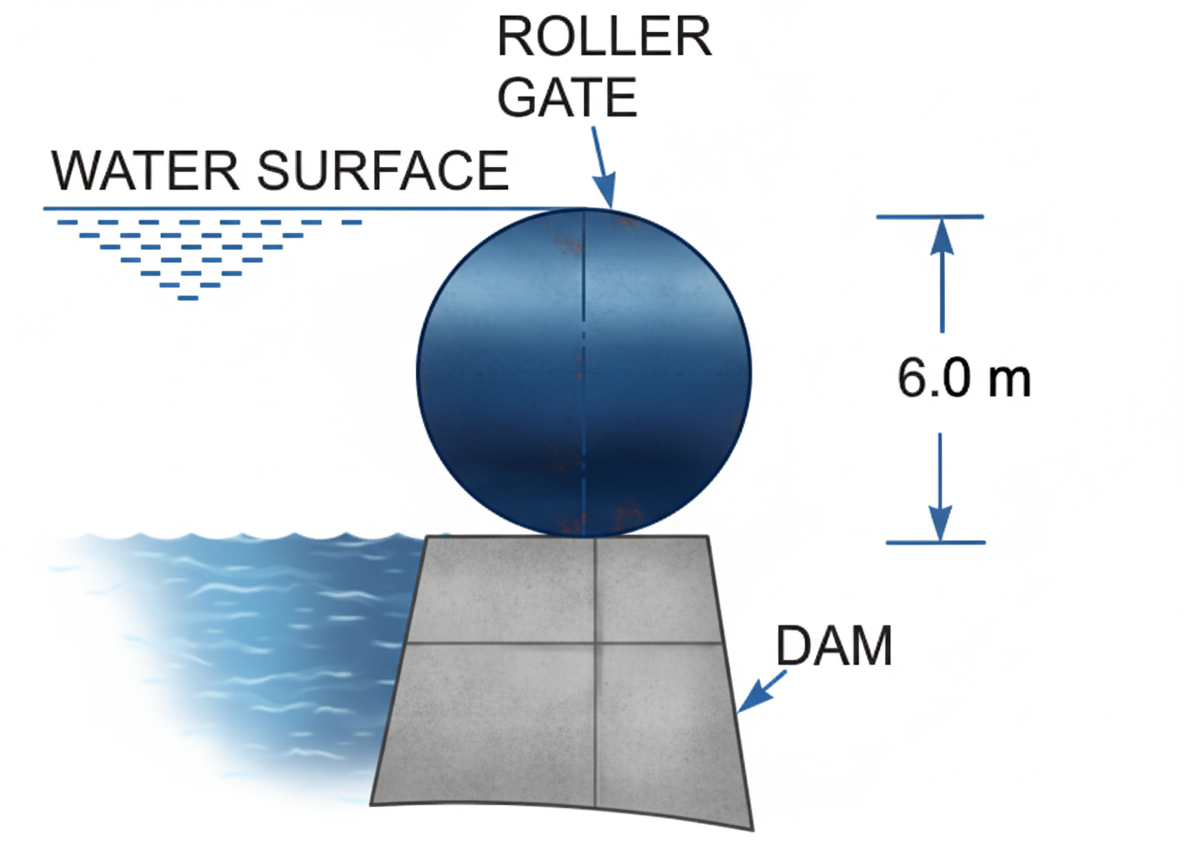
A roller gate is in cylindrical form of 6.0 m diameter. It is placed on the dam. Find the magnitude and direction of the resultant force due to water acting on the gate when the water is just going to spill. The length of the gate is given as 10 m.

Cylindrical Roller Gate Problem Problem Statement A roller gate is in cylindrical form of 6.0 m diameter. It is placed

A roller gate is in cylindrical form of 6.0 m diameter. It is placed on the dam. Find the magnitude and direction of the resultant force due to water acting on the gate when the water is just going to spill. The length of the gate is given as 10 m. Read More »

A gate having a quadrant shape of radius of 3 m is positioned as shown in the figure below. Find the resultant force due to water per metre length of the gate. Find also the angle at which the total force will act.

Quadrant Gate Resultant Force Problem Problem Statement A gate having a quadrant shape of radius of 3 m is positioned

A gate having a quadrant shape of radius of 3 m is positioned as shown in the figure below. Find the resultant force due to water per metre length of the gate. Find also the angle at which the total force will act. Read More »

A curved gate AB, in the form of a quadrant of a circle with a 2 m radius, is positioned as shown in the figure below. The center of the circle, O, is 4 m below the free water surface. Find the horizontal and vertical components of the total force on the 2 m wide gate.

Curved Quadrant Gate Problem Problem Statement A curved gate AB, in the form of a quadrant of a circle with

A curved gate AB, in the form of a quadrant of a circle with a 2 m radius, is positioned as shown in the figure below. The center of the circle, O, is 4 m below the free water surface. Find the horizontal and vertical components of the total force on the 2 m wide gate. Read More »

Find the total pressure and depth of centre of pressure on a triangular plate of base 3 m and height 3 m which is immersed in water in such a way that the plane of the plate makes an angle of 60° with the free surface. The base of the plate is parallel to the water surface and at a depth of 2 m from the water surface.

Inclined Triangular Plate Problem Problem Statement Find the total pressure and depth of centre of pressure on a triangular plate

Find the total pressure and depth of centre of pressure on a triangular plate of base 3 m and height 3 m which is immersed in water in such a way that the plane of the plate makes an angle of 60° with the free surface. The base of the plate is parallel to the water surface and at a depth of 2 m from the water surface. Read More »

A gate supporting water is shown in the figure below. Find the height ‘h’ of the water so that the gate begins to tip about the hinge. Take the width of the gate as unity.

Tipping Gate Problem Problem Statement A gate supporting water is shown in the figure below. Find the height ‘h’ of

A gate supporting water is shown in the figure below. Find the height ‘h’ of the water so that the gate begins to tip about the hinge. Take the width of the gate as unity. Read More »

Scroll to Top