Table of Contents
ToggleIntroduction
Tacheometry is a specialized field within surveying that enables the determination of both horizontal and vertical distances between stations through instrumental observations. This method eliminates the need for traditional measuring tools such as tapes or chains, offering a more efficient approach to distance measurement.
One of the key advantages of tacheometric observations is that the horizontal distances obtained do not require corrections for slope or tension, which are typically necessary with other methods. This feature, combined with its speed and convenience, makes tacheometry particularly valuable in surveying applications.
While the accuracy of tacheometric measurements may not match that of direct chaining on level terrain, it proves superior in challenging environments such as broken grounds, deep ravines, or when surveying across large bodies of water. In these scenarios, tacheometry offers a more practical and precise alternative to conventional chaining methods.
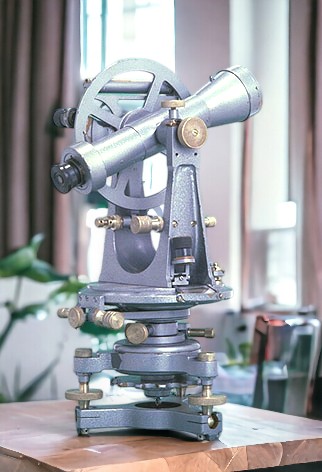
The primary instrument used in tacheometry is the tacheometer, which closely resembles a theodolite. The distinguishing feature of a tacheometer is its diaphragm, which is equipped with two additional horizontal wires known as stadia hairs. These stadia hairs play a crucial role in the measurement process.
Under favorable conditions, tacheometric measurements can achieve remarkable accuracy. Typically, the margin of error does not exceed 1 in 1000, demonstrating the method’s reliability for various surveying applications.
Purpose of Tacheometric Surveying
The principal aim of tacheometric surveying is the creation of contoured plans (making contours). This method has gained widespread acceptance among engineers, particularly for its efficiency and accuracy in challenging terrains. As a result, tacheometry has become an invaluable tool in various location surveys, including those for railways, canals, and reservoirs.
Tacheometry’s utility extends beyond rough landscapes. In surveys requiring higher precision, it serves as an excellent verification method for distances obtained through traditional means such as tape or chain measurements. This dual functionality – as both a primary surveying method and a validation tool – underscores its versatility in the field of surveying.
The technique’s ability to rapidly produce accurate results in diverse environments has contributed to its popularity. It offers a balanced combination of speed and precision, making it particularly suitable for large-scale projects where time efficiency is crucial without compromising on accuracy.
Moreover, tacheometry’s capacity to simultaneously determine both horizontal and vertical distances enhances its value in creating comprehensive topographical surveys. This feature is especially beneficial in producing detailed contour maps, which are essential for many engineering and construction projects.
Instrument used in Tacheometric Surveying
The following instruments are essential for tacheometric surveying:
- Tacheometer. This instrument is fundamentally a theodolite equipped with stadia hairs, specifically designed for tacheometric surveying. Its key feature is the stadia diaphragm, which includes two stadia hairs positioned equidistant above and below the horizontal cross hair. These stadia hairs are aligned in the same vertical plane as the horizontal and vertical cross hairs. Figure below illustrates various designs of stadia diaphragms commonly found in tacheometers.
- Stadia rods. The choice of stadia rod depends on the distance being measured. For distances up to approximately 100 metres, standard levelling staves are typically sufficient. However, for measurements beyond this range, specialized stadia rods measuring 3 to 5 metres in length are employed. These longer rods enhance visibility and reading accuracy at greater distances.
The combination of a tacheometer and appropriate stadia rod enables surveyors to efficiently determine both horizontal and vertical distances across diverse terrains, making tacheometry a versatile surveying method.


Principle of Tacheometry
The fundamental principle of tacheometry is based on the properties of isosceles triangles. This principle can be stated as follows:
“In isosceles triangles, the ratio of the perpendiculars from the vertex to their bases remains constant.“

This principle can be demonstrated mathematically:
Consider two isosceles triangles, ABC and AB’C’, with bases BC and B’C’ respectively, and a common vertex A. Let AO and AO’ be perpendiculars drawn from vertex A to the respective bases.
We can then establish that:
AO / BC = AO’ / B’C’ = 1/2 cot(α/2) = K
Where:
- α is the apex angle
- K is a constant
The value of constant K is solely determined by the magnitude of the apex angle α. This relationship forms the cornerstone of tacheometric calculations.
For horizontal sights in tacheometry, the difference in elevations between the instrument station and the staff position is calculated using a method similar to differential levelling. This allows for the simultaneous determination of both horizontal distances and elevation differences, which is a key advantage of tacheometric surveying.
This principle enables surveyors to determine distances and elevations without direct physical measurement, making tacheometry particularly useful in challenging terrains or when rapid surveys are required.
Systems of Tacheometric Measurements
Tacheometric measurements are conducted using one of two main systems:
(i) The stadia hair system (ii) The tangential system
(i) The stadia hair system
This system is further divided into two methods:
a) Fixed hair method:
In this method, stadia hairs are set at a fixed interval. The intercept on the levelling staff or stadia rod varies based on the horizontal distance between the instrument station and the staff. The intercept used in calculations is obtained by subtracting the lower stadia reading from the upper stadia reading. When the staff intercept exceeds the staff length, only half the intercept is read, equal to the difference between the central stadia hair reading and either the lower or upper stadia hair reading.
This method is versatile and can be used even when horizontal sights are not possible. For inclined sights, readings can be taken with the staff held either vertically or normal to the line of sight. This is the most common tacheometric method, and the term “stadia hairs method” typically refers to this approach.
b) Movable hair method:
Movable hair method. In this method, the intercept on the levelling staff is kept constant while the distances between the stadia hairs are variable. Two targets are fixed on the staff at a known distance apart. The stadia hairs are then adjusted so that the upper hair bisects the upper target and the lower hair bisects the lower target. A provision is made to measure the variable interval between the stadia hairs. For inclined sights, readings can be taken by holding the staff either vertical or normal to the line of sight, similar to the fixed hair method.
(ii) The tangential system
In the tangential method, stadia hairs are not utilized. Instead, readings are taken on a staff using the horizontal cross-hair of the telescope. To determine the staff intercept, two separate pointings of the telescope are required. This process usually involves recording readings to full meter values, which helps to eliminate the need for decimal computations and simplifies the overall calculation process.
Due to the requirement of measuring two vertical angles for a single observation, this method is less commonly employed in practice.