
Table of Contents
ToggleIntroduction
A theodolite is an instrument designed for the precise measurement of horizontal and vertical angles. It was initially developed in 1690 by Ole Roemer, a Danish astronomer, to observe the passage (or transit) of stars across different segments of the celestial meridian. Around a century later, the theodolite underwent modifications to meet surveying requirements, enabling it to measure both horizontal and vertical angles more effectively. By 1830, additional enhancements further expanded its range of applications, allowing it to measure a variety of parameters beyond simple angles.
Because of its versatile functionality, a theodolite is often regarded as a universal instrument. It is employed in various tasks, such as measuring horizontal and vertical angles, extending straight lines, determining bearings, calculating horizontal and vertical distances, and establishing the direction of true north. Although the exact origin of the term “theodolite” remains unclear, it is distinguished from a transit instrument primarily by its longer size and its ability to read smaller angular values, even to 1 second of arc, making it more precise than a standard transit.
Types of Theodolites
Types of Theodolites Based on Reading Mechanism:
Theodolites can be categorized based on the mechanisms used for reading observations and the level of precision they offer. These classifications include:
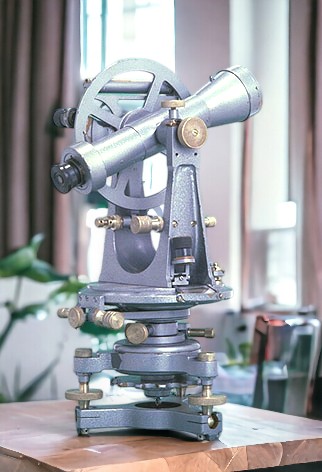
Vernier Theodolites:
Vernier theodolites are among the earliest forms of the instrument and feature a vernier scale for reading angular measurements. Though considered less advanced than modern counterparts, vernier theodolites remain widely used in instructional settings. Their straightforward structure makes them ideal for understanding the basic components and functions of the theodolite, making them an essential educational tool.
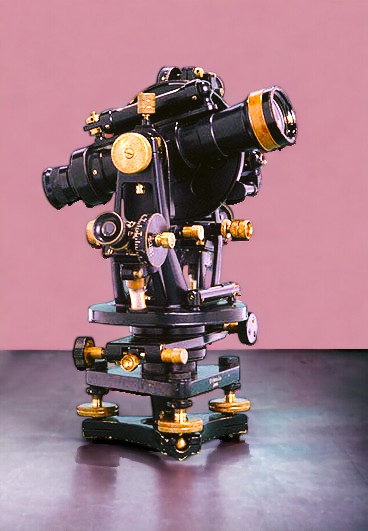
Micrometer Theodolites:
Equipped with a micrometer for taking readings, these theodolites offer greater precision than their vernier counterparts. The micrometer theodolite allows for more accurate measurements of smaller angular values, making it suitable for applications where fine accuracy is required. However, with the advent of digital theodolites, micrometer theodolites have become largely obsolete.
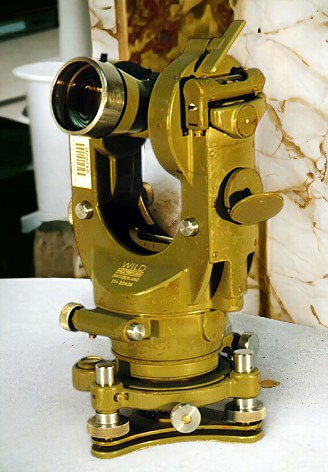
- Optical (Glass Arc) Theodolites:
This type of theodolite employs an optical system that uses a glass arc to read angles. The optical mechanism improves accuracy and reduces parallax error, making these instruments highly reliable for detailed fieldwork. Optical theodolites are still used in some traditional surveying practices, though they are being gradually replaced by more advanced electronic versions.
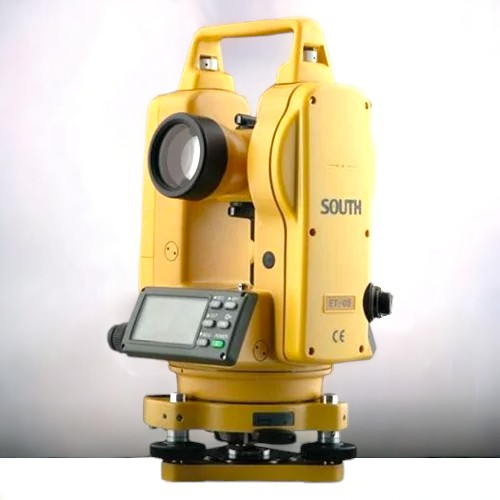
- Electronic Theodolites:
These modern theodolites feature digital readouts and electronic systems to measure angles, making observations easier and more precise. Electronic theodolites are preferred for most contemporary surveying tasks due to their accuracy, ease of use, and the ability to integrate with data recording devices. They have largely replaced older models like vernier and micrometer theodolites in professional surveying.
Types of Theodolites based on the Movement of the Telescope Around its Horizontal Axis:
Theodolites can be broadly categorized into two main types: Transit Theodolites and Non-Transit Theodolites.
Transit Theodolite: A transit theodolite is equipped with a telescope that can be rotated 360 degrees around its horizontal axis in a vertical plane. This complete revolution capability allows for the precise measurement of angles in both horizontal and vertical directions. Due to this feature, transit theodolites are the preferred choice for most modern surveying applications.
Non-Transit Theodolite: In contrast, a non-transit theodolite cannot be rotated entirely around its horizontal axis. Because of this limitation, non-transit theodolites have become almost obsolete and are seldom used in current surveying practices.
Types of Theodolites Based on Design
Various specialized theodolites have been developed over the years to meet specific requirements:
Vernier Transit Theodolite: The simplest and most widely used type, the vernier transit theodolite is named for its ability to transit or rotate its telescope around the horizontal or transverse axis through a complete revolution. Readings are taken with the help of vernier scales provided on the horizontal plate. The size of a vernier transit theodolite is defined by the diameter of its main scale plate, such as a 15 cm or 20 cm theodolite. The primary scale is graduated in degrees, with each degree divided into 3 equal parts, making each small division equivalent to 20 minutes.
Double Arc Theodolite: This type of theodolite features two graduated arcs, one for measuring horizontal angles and another for vertical angles, providing higher accuracy.
Watts Micrometer Theodolite: Equipped with a micrometer, this theodolite offers enhanced precision for measuring fine angular values.
Tavistock Theodolite: A specialized design developed for high-precision engineering and geodetic measurements.
- Wild T2 Theodolite: A compact and highly accurate instrument, the Wild T2 is used for medium-precision surveys, offering a balance between portability and functionality.

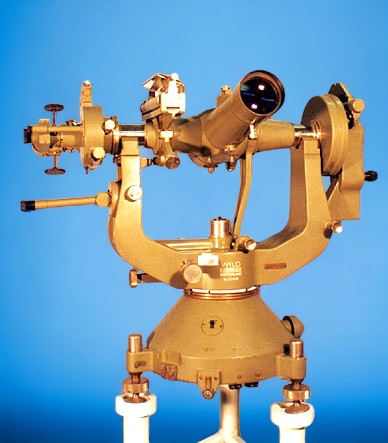
- Wild T4 Theodolite: Known for its exceptional precision, the Wild T4 is used in highly sensitive geodetic work and advanced surveying tasks that demand extremely fine angular measurements.
Modern Theodolites
Today’s theodolites are compact, lightweight, and built with rugged designs, making them suitable for use in harsh field environments. All moving components and scales are enclosed, providing protection against dust and moisture. The size of a theodolite is typically defined by the diameter of its lower graduated circle. For example, a 20 cm theodolite refers to a model where the diameter of the lower plate’s graduated circle is 20 cm. Depending on the model, theodolite sizes can range from 8 cm to 25 cm, catering to various project requirements.